
Among the diverse Ikat traditions of India, the Telia Rumal stands out as a rare and historic example of Andhra Pradesh’s textile mastery. Originating from Chirala, this unique fabric is a square-shaped handloom textile, usually measuring about one meter, and follows the intricate Ikkat Tie and Dye weaving technique.
Telia Rumal Sarees
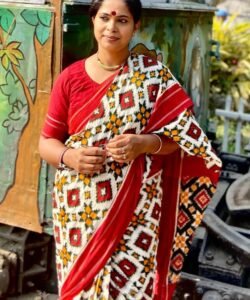
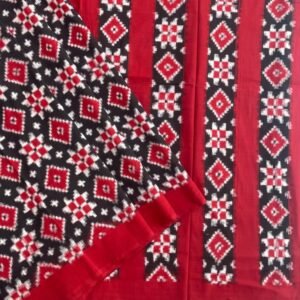
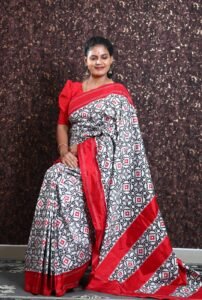
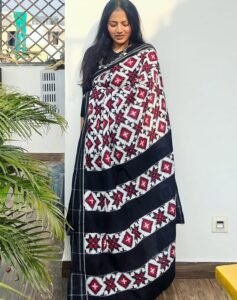
The name Teliya Rumal is derived from the word “Tel,” meaning oil. In the traditional process, cotton yarns were treated with a special oil-based solution before dyeing to achieve a deep and long-lasting color. This technique not only gave the fabric its distinctive earthy fragrance but also made it soft and durable.
The Padmasali weaver community crafted these textiles during the 19th century, and they were widely exported to the Middle East, Burma, and East Africa. Within India, fishermen and laborers used them as turbans, scarves, or lungis, owing to their comfort and resilience. The color palette was typically terracotta red, black, and white, created from natural dyes sourced from roots, minerals, and plants. Each piece featured geometric grids, crosses, and diamond motifs, with decorative borders surrounding the design. Later, as artistry evolved, motifs such as birds, stars, and floral patterns were incorporated, enhancing the visual appeal.
As the global demand for handkerchief-sized rumals declined in the early 20th century, artisans intelligently adapted the Thalia Rumal patterns into Ikkat sarees, fabrics, duppattas and home textiles. The same double Ikat weaving method, involving pre-dyed warp and weft yarns, was retained, preserving the ancient weaving logic while giving it new commercial life.
Also read: Single Ikkat vs Double Ikkat
The Thalia Rumal represents not just a piece of fabric but a living testament to India’s textile innovation. Each step—from oil treatment to dyeing and precise weaving—demonstrates the skill, patience, and scientific understanding of traditional weavers. Today, it stands as an early symbol of Andhra Pradesh’s Ikkat heritage, influencing modern Pochampally Cotton Sarees, Ikkat Silk Sarees, and Cotton Silk Ikkat Sarees across the region.
FAQ’s
Telia Rumal sarees are unique for their oil-treated Ikat yarns and traditional double Ikat weaving technique. The yarns are soaked in castor oil and natural ingredients before dyeing, giving the fabric a rich texture, durability, and deep natural color. This traditional process also gives the saree its name — Telia means oil in Telugu.
These sarees were originally woven in Chirala (Andhra Pradesh) before 1950 and later flourished in Puttapaka village, Pochampally village (Telangana). Today, Puttapaka is known as the modern hub for authentic Telia Rumal sarees, and the craft has received a Geographical Indication (GI) Tag for its cultural significance.
Telia Rumal sarees are woven in both cotton and silk varieties.
Cotton sarees are soft, breathable, and perfect for everyday or festive wear.
Silk sarees are luxurious, featuring fine mulberry silk threads and zari borders, ideal for special occasions.
Both belong to the Ikat family of weaves, but Telia Rumal stands apart due to its oil treatment process and the traditional red, black, and white color palette. Pochampally Ikat, on the other hand, uses brighter color combinations and more geometric or floral motifs without the oil treatment.
The price depends on the fabric and intricacy of design:
Telia Rumal Cotton Sarees: ₹7,000 – ₹10,000
Telia Rumal Silk Sarees: ₹21,000 – ₹22,000
Telia Rumal cotton sarees are ideal for traditional gatherings, festivals, and cultural functions. Silk Telia Rumal sarees are perfect for weddings, festive ceremonies, and special celebrations where heritage style meets elegance.
Sharp geometric patterns (not printed).
Slight blurriness characteristic of true Ikat.
A soft texture due to the oil-treated yarn.
The GI Tag mark for Puttapaka Telia Rumal.